Before a Kpop Song Makes the Album
A lead opens an opportunity. A pitch puts a song forward. Choosing the repertoire is a different decision.
Choosing which songs an artist will record is best called song selection or repertoire selection. Pitching means presenting a song for consideration. In K-pop publishing conversations, a lead usually identifies a request or opportunity to supply music. The words describe different parts of the process, even when people use them in the same meeting. Understanding the distinction makes an album’s early development much easier to follow.
The lead describes the opening
A label may be looking for songs for a particular artist or project. That request can circulate through publishers and their writers as a lead. In an October 2025 interview with The Music Business Buddy, publishing A&R Kristin Hurst described receiving leads from labels, sharing them with writers, reviewing tracks and pitching suitable songs. That is one working model, rather than a rule every project must follow. [1]
The brief supplies the musical direction. In her 2021 songwriting-camp diary for Teen Vogue, Rakiyah described briefs within label-supplied leads, covering the intended artist, genre and reference tracks. The terms can overlap or appear in the same document: the lead identifies the opportunity; the brief explains the music being sought. Here, lead is publishing vocabulary, separate from the release-marketing term lead single. [2]
The pitch puts a song forward
Pitching is the act of proposing material. A songwriter might present a demo to a publisher; a publisher or other representative might put a song in front of a label, producer or artist. BMI’s songwriting guidance describes pitches as getting songs heard by the people who can take them forward. The demo is the listening material; the pitch is the proposal around it. Sending one does not establish that the song has been chosen. [3]
A pitch is the proposal.
Selection is another decision.
Nor does every pitch begin with a new lead. In a 2022 Korea Times interview, A&R consultant Marion Van der Wees described both responding to label briefs and proposing songs independently because she thought they suited an artist. An existing catalog song can therefore enter the process alongside newly written material. Hurst also described renewed interest in a song written years earlier. The path is less orderly than a simple request–write–submit diagram suggests. [4] [1]
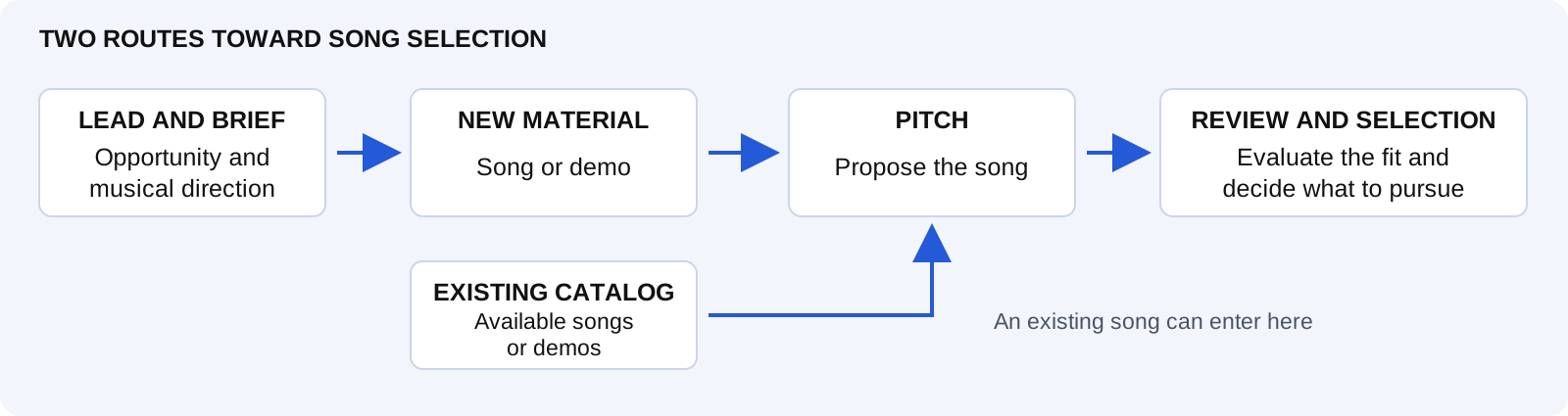
Route A · New materialLead and brief → new song or demo → pitch → review and selection.
Route B · Existing catalogAn available song or demo → pitch → review and selection.
Selection belongs to the project
Song selection asks a further question: should this piece become part of this artist’s repertoire? A&R, short for artists and repertoire, can help source material and coordinate its development. But the artist, producers and other label decision-makers may also shape the outcome. The balance differs by project; the job title alone does not reveal who has final approval.
Weverse Magazine’s account of BTS’s English-language singles offers a concrete example. BIGHIT MUSIC A&R team leader Nicole Kim described sourcing songs around the members’ intended message, coordinating changes with collaborators and receiving the members’ positive response to “Butter.” Selection and development involved an exchange among people with different responsibilities. It is evidence of a collaborative process, not a universal approval chart. [5]
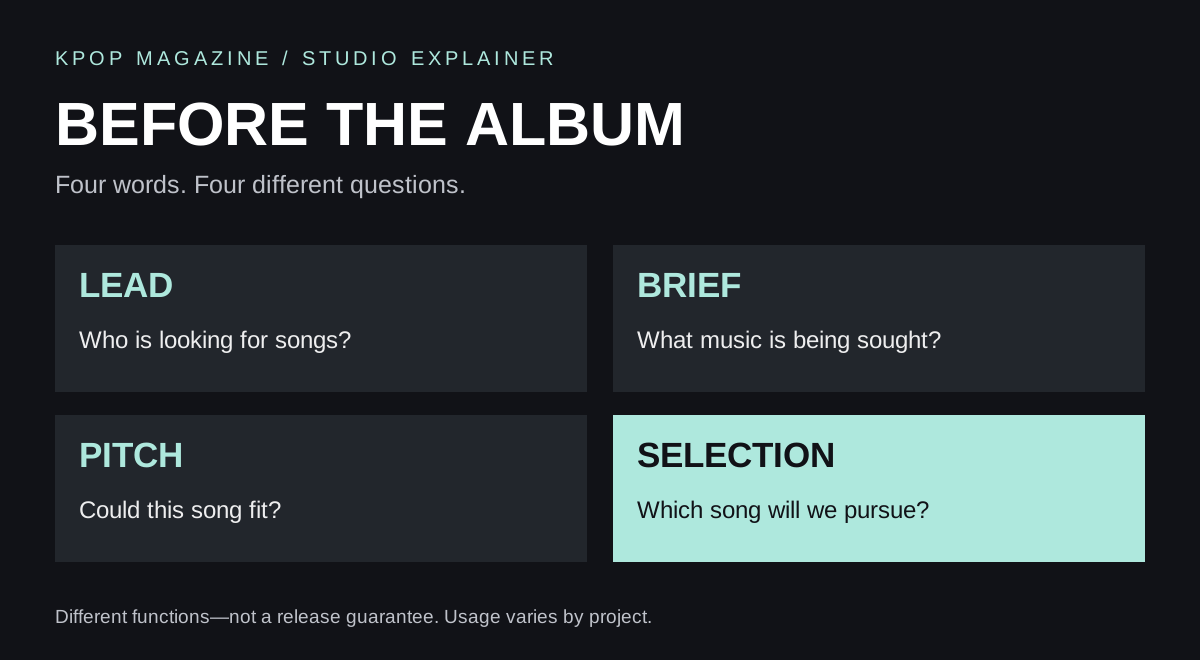
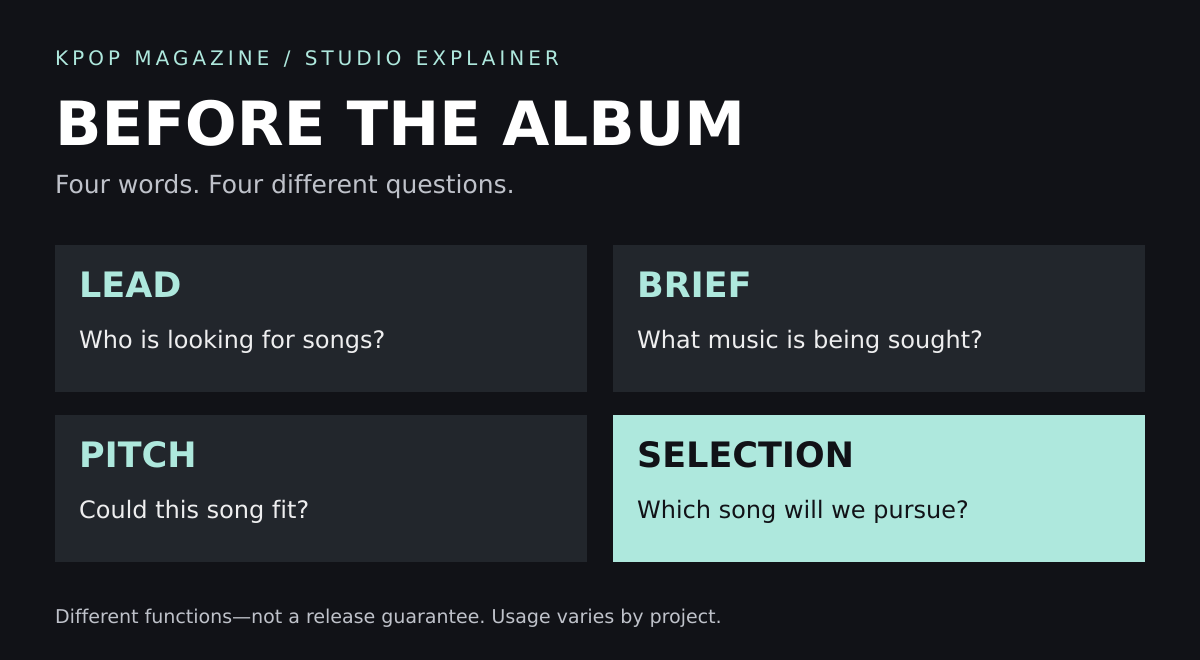
Four terms at a glance
- Lead
- Request or opportunityWho is looking for songs?
- Brief
- Creative directionWhat music is being sought?
- Pitch
- Song proposal or submissionCould this song fit?
- Selection
- Repertoire decisionWhich song will we pursue?
Usage varies across companies; a lead and its brief may share one document. These are useful distinctions for following a project, not a standardized approval system.
One fictional album in practice
Imagine an artist preparing an EP. The team asks for a rhythmic pop song with a restrained verse and an expansive chorus. The opportunity is the lead; those musical instructions form the brief. A publisher finds one suitable demo in its catalog and receives another from a writing session. Presenting those candidates to the artist’s team is pitching.
- The request: an artist’s team is looking for material.
- The direction: rhythmic pop, restrained verse, expansive chorus.
- The proposal: a catalog demo and a newly written song are presented.
- The review: the team discusses vocal fit and requests a revised chorus.
- The choice: the project decides which song to pursue for recording.
The team listens, discusses the vocal fit and asks to hear a revised chorus on one song. That is evaluation and development. If the project then chooses the song to record, that is song selection. A favorable response, a revision request and a confirmed choice should be described separately. This example is fictional; it illustrates vocabulary rather than prescribing a label’s workflow.
Name the moment accurately
For an album diary, use captions that match the event: developing the brief, receiving pitches, reviewing demos or selecting repertoire. They tell readers what actually happened without turning an early conversation into a release announcement. Choosing an album song and deciding which track will lead the campaign are also distinct questions. The most useful language keeps the proposal, the creative decision and the eventual release visible as separate milestones.
Sources & editorial notes
- Kristin Hurst on The Music Business Buddy — Episode 66, Inside K-Pop’s Music Publishing System. October 8, 2025. Leads and pitching at 8:46–9:35; older catalog material at 10:34–11:59.
- Rakiyah’s songwriting-camp diary in Teen Vogue — Inside a K-Pop Songwriting Camp With R&B Musician Rakiyah. August 24, 2021; editorial byline P. Claire Dodson. First-person account, section 4.
- Jason Blume for BMI — Pitch Perfect: How to Shop Your Songs. November 13, 2015. Guidance on presenting material to music-industry decision-makers.
- Marion Van der Wees in The Korea Times — Interview by Dong Sun-hwa. Published April 13, 2022; updated April 14. Firsthand account of responding to briefs and proposing songs independently.
- Nicole Kim in Weverse Magazine — How Permission to Dance came to be, by Haein Yoon. Listed in the publisher’s archive as August 12, 2021. Artist input, song sourcing and coordination with collaborators.
Based on S.I.Q.’s manuscript Before a Kpop Song Makes the Album, edited for KPOP MAGAZINE. Sources checked October 7, 2026. Named examples come from published firsthand accounts, paraphrased here. The EP scenario and graphics are explanatory material, not evidence of a particular label’s internal process. This article contains no song lyrics or reproduced third-party photographs.
Visual credits
Workflow diagram: original KPOP MAGAZINE artwork supplied with Kpop Leads, Pitching and Song Selection, October 7, 2026; vector artwork preserved, with a text alternative for small screens. Four-term diagram: original KPOP MAGAZINE graphic created from the manuscript’s terminology table. All graphic text and shapes are publisher-created; no third-party photos or logos are included. Four-term vector graphic · Workflow vector graphic.