Can Suno Create Music — or Only Generate It?
Suno can generate a finished song. The harder question is what the human contributes—and when that contribution becomes creation.

A song can now begin with a sentence.
You can describe a mood, a genre, a scene or a story, press a button, and within minutes hear vocals, harmony, arrangement and production that did not exist before. Suno presents itself as a tool capable of turning ordinary language into complete songs, and its latest models go further than one-shot generation.
That makes the technical question increasingly easy to answer. Yes, Suno can make music. The more difficult question is this: Can Suno create music?
Those two sentences may sound almost identical. They are not.
Generation and creation are not necessarily the same thing
When a musician writes a melody at a piano, we instinctively describe the act as creation. When a producer programs drums, changes the harmony, rewrites a chorus and spends three hours deciding whether a snare should arrive slightly earlier, we also call that creation.
But when someone types “A melancholic alternative pop song about seeing an ex again at midnight” and receives a finished track, our language suddenly becomes less certain.
Who created it? The person who described it? The model that produced the melody and arrangement? The people whose musical work contributed, directly or indirectly, to the development of the system? Or is “creator” simply the wrong word for what happened?
This uncertainty comes from the fact that music creation has traditionally been a process in which decisions and execution were closely connected. Generative systems can separate them. The human can decide what they want without necessarily deciding how every note gets there.
But musicians have never controlled every part of the process
There is an easy trap here. If we define creation as personally executing every musical decision, much of modern music would fail that test.
A songwriter may write chords and melody, then hand the song to an arranger. A producer may ask a guitarist to try something “more restrained.” A singer may change the phrasing of a line and transform the emotional meaning of the song. An orchestral arranger may decide voicings the songwriter never imagined. A mix engineer can change the perceived weight and intimacy of an entire record.
Popular music has always been collaborative. So the fact that one person does not directly construct every note cannot, by itself, disqualify them from a creative role.
Where are the meaningful decisions being made?
Suno is becoming less like a button and more like a working environment
That question has become harder because Suno itself has changed. Its September 9 introduction of v6 describes section-level editing, combining source material, text, audio, image and video inputs, and changing individual lyrics while preserving the rest of a track.
Studio 2.0, announced August 13, adds MIDI recording and editing, effects, a wavetable synthesizer and automation to its multitrack environment. These are tools associated with a conventional digital audio workstation, not simply a prompt box. Studio 2.0 is offered to Premier subscribers; access is not identical across every plan.
Imagine two users. The first types one prompt, listens once, downloads the first result and uploads it. The second generates twenty versions, rewrites the lyrics, replaces the chorus, changes the arrangement, records a vocal idea, edits MIDI, removes instruments, rebuilds the bridge and mixes the final version.
Both used Suno. But it is difficult to argue that they participated in the creative process to the same degree. The tool is the same. The contribution is not.
Selection itself can be creative
One of the least discussed parts of creative work is selection. Film directors do not manufacture cameras. Fashion editors do not weave every fabric. Record producers do not necessarily play every instrument. Yet choosing between possibilities is often one of the most important creative acts.
A producer listening to ten takes and saying, “That one” is making a creative decision. A photographer choosing one image from 500 is making a creative decision. A songwriter deleting the cleverest line because it does not fit the song is making a creative decision.
So when someone generates dozens of musical possibilities and recognizes the one that expresses what they were trying to say, that choice is not meaningless. But selection alone has limits.
Pressing “generate” repeatedly until something pleasing appears is not automatically equivalent to years of composition, performance or production skill. There is a difference between having taste and having authorship. Sometimes they overlap. Sometimes they do not.
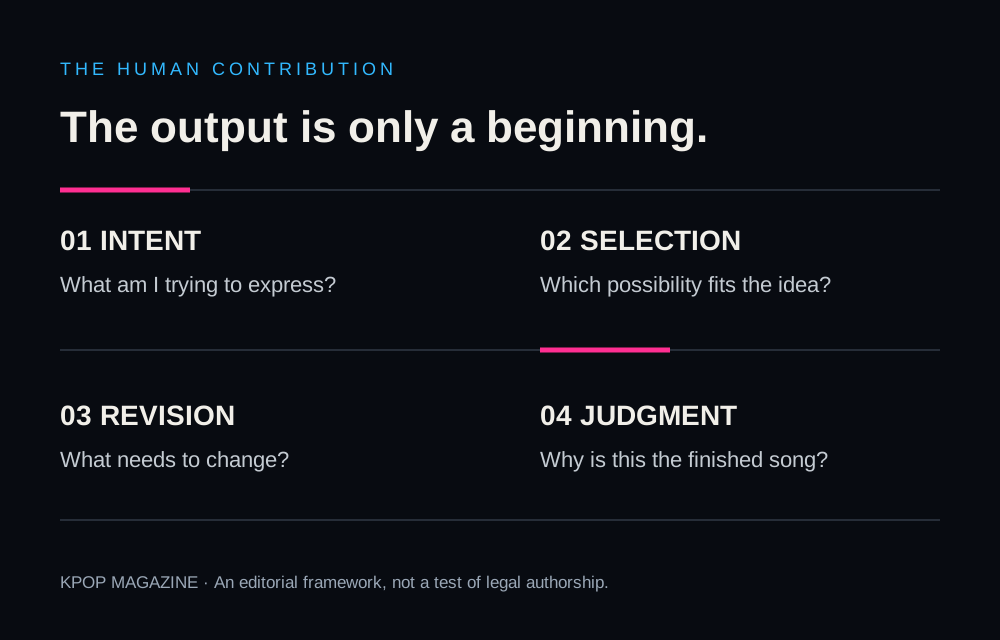
Intent may be the dividing line
Perhaps the strongest distinction is not human versus machine. It is intent versus accident.
Did the person begin with something they wanted to express? Did they recognize when the result was wrong? Could they explain why a different chord, voice, tempo or arrangement would make the song better? Did they continue shaping the work until it reflected a particular idea? Or did they simply accept whatever sounded impressive?
The more intentional the process becomes, the easier it is to recognize a human creative role. The less intentional it becomes, the more the user begins to resemble a listener choosing from generated possibilities.
That distinction already exists outside AI. Someone can own a piano without being a pianist. Someone can own a camera without being a photographer. And someone can have access to a powerful music generator without necessarily becoming a songwriter.
The tool lowers the barrier to producing an output. It does not automatically supply artistic intent.
Good music and authorship are separate questions
“Is the song good?” and “Who created the song?” are two different questions.
A listener may love a generated song without caring how it was made. Another listener may reject it because of the process behind it. Both responses are possible because aesthetic value and authorship are not the same thing.
The legal and ethical questions are not settled either. Reuters reported on September 1 that musicians including Jason Isbell sued Suno, alleging unauthorized use of their identities to enable imitation. Suno disputed the claims and said it supports original music with safeguards against misuse. Those are allegations and a company response, not findings of liability.
This essay uses authorship in a creative sense; it is not a determination of copyright ownership. Even if every legal dispute disappeared tomorrow, the creative question would remain: what does it mean to make music when the distance between an idea and a finished recording has collapsed?
The role of the musician may be changing
For much of recording history, technical ability acted as a gate. To hear an orchestral arrangement, someone had to compose it, orchestrate it, perform it or program it. To hear a convincing singer, someone had to sing. A finished record required musicians, engineers, equipment and time.
Generative music weakens that relationship. An idea can reach the form of a recording before the person behind it has acquired the skills that once made that recording possible.
That will make some people uncomfortable. It may also create new kinds of musicians: creators whose primary ability is not instrumental performance or traditional composition, but direction—defining an idea, identifying what works, rejecting what does not and reshaping generated material until it becomes personal.
Some will do this superficially. Others may become extraordinarily skilled at it. As with earlier technological shifts in music, new tools can move some skills away from the center and make others more important.
So, can Suno create music?
Suno can certainly generate music. Its current editing tools also let users reshape generated material as part of arrangement and production.
But creation is harder to assign to software alone. Creation implies more than the existence of a new file. It suggests intention, judgment, selection and meaning. A machine can produce possibilities. A human can decide why one of those possibilities deserves to exist.
That does not mean every person who types a prompt is suddenly a composer. And it does not mean music made with Suno cannot involve genuine creativity.
The more useful question may no longer be “Was AI used?” It may be:
What did the person actually contribute?
Because Suno can generate music. Whether that generation becomes creation depends on what the human does next.