How BOYFRIEND Connects Three HOSHI Singles
Jin Jeon returns from “SNAPBACK.” Heon Seo returns from “Baby, Honey.” Their credits place HOSHI’s October 10 single inside a developing network of solo collaborators.

The photograph provides a clear view of HOSHI without borrowing artwork or a still from the new release.
HOSHI on April 15, 2024. Photo by K-POPIT 케이팝잇, via Wikimedia Commons, CC BY 3.0. Original file reproduced without crop or retouch. No endorsement implied.

HOSHI’s new single puts a beginner’s question into the hands of familiar collaborators. “BOYFRIEND” arrived on October 10 at 6 p.m. KST, the time specified in PLEDIS Entertainment’s release notice. Its credits connect it to two earlier 2026 singles: March’s “Baby, Honey” and June’s “SNAPBACK.”
That connection gives the new release a useful place in his solo catalog. Put the three songs together and a small network emerges: HOSHI remains involved in the words, while collaborators return in different combinations. The musical roles change along with the romantic situations the songs describe.
Two routes into BOYFRIEND
“Baby, Honey,” released on March 14 and titled “아기자기” in its Korean listing, includes HOSHI and Heon Seo among its lyricists and composers. Heon Seo also shares the arrangement credit and receives the chorus credit. His contribution therefore extends across several parts of the recording, from writing to supporting vocals.
The June 15 single “SNAPBACK” introduces the other connection. Its lyric and composition credits name HOSHI, Jin Jeon, Benjamin Boukris, Salem Ilese and JT Roach. Boukris also receives credits for bass, drum programming, keyboard and synthesizer, while Glenn supplies the chorus.
On “BOYFRIEND,” Jin Jeon and Heon Seo appear together in both the lyric and composition lists. HOSHI joins them on lyrics. The new single therefore connects two writing partnerships already visible in this year’s releases. That is a specific, traceable continuity, without assuming that the recordings sound alike or that one collaborator shaped a particular passage.
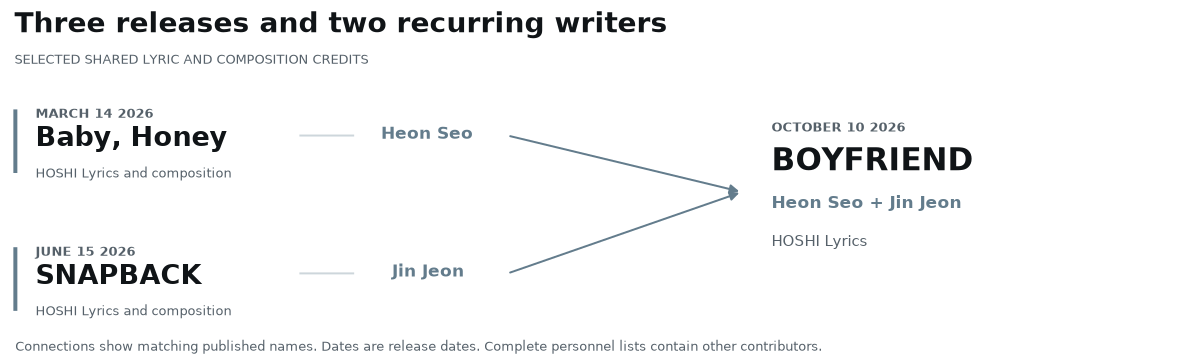
Listen outward from one contributor: Heon Seo leads back to “Baby, Honey”; Jin Jeon leads back to “SNAPBACK.”
The returning names suggest a better way to explore an artist’s catalog. Follow Heon Seo from “Baby, Honey” to “BOYFRIEND,” then follow Jin Jeon back to “SNAPBACK.” The same three songs become two overlapping listening routes.
The voice has company
Heon Seo’s return is especially useful because the new credits place him beyond the writing room: he receives the chorus credit on “BOYFRIEND,” as well as the recording credit. This creates a documented vocal connection with “Baby, Honey,” where his chorus contribution is also listed.
The instrumental jobs on the new single are divided differently. Hey Farmer is credited for bass and drums; 이범훈 handles keyboard and synthesizer. They share the arrangement credit. PLEDIS’s release notes describe the track as R&B-based pop with a shuffle groove and bright synthesizers.
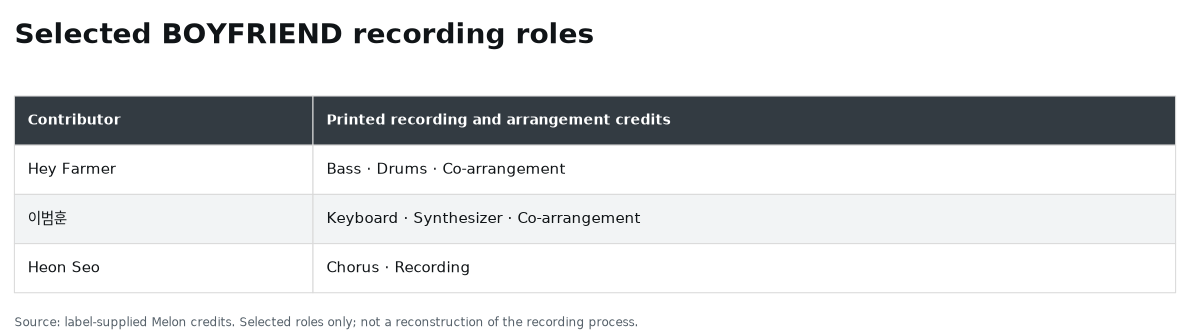
Hey Farmer
Bass · Drums · Co-arrangement
이범훈
Keyboard · Synthesizer · Co-arrangement
Heon Seo
Chorus · Recording
Those credits give listeners something concrete to follow: the rhythm, the keyboard textures and the voices around HOSHI. How closely do the supporting vocals follow the lead? Where does the accompaniment give a phrase more room? These are questions to take into the recording, rather than conclusions supplied by the personnel list.
Watch BOYFRIEND
Begin with the official performance film, then replay one section while following the rhythm, keys and supporting voices separately.
HOSHI / SEVENTEEN official performance film · Open on YouTube ↗A different kind of confidence
The lyrics provide another route through the three singles. “Baby, Honey” places its speaker inside shared intimacy, using affectionate names and everyday closeness. “SNAPBACK” presents attraction with the certainty that it will be returned.
“BOYFRIEND” moves to an earlier, less practiced position. Its speaker wants to approach someone but also asks to learn from them. The brief request “teach me” sits beside repeated declarations of readiness. In this reading, confidence comes from being willing to begin while still feeling inexperienced. The contrast is in the speaker’s stance, not evidence of an autobiographical sequence.
HOSHI’s own credit changes, too. “Baby, Honey” and “SNAPBACK” list him for lyrics and composition; “BOYFRIEND” lists him for lyrics. Those categories deserve to stay distinct. They describe documented roles without assigning percentages of creative control or identifying who invented a particular hook.
Listen to the new single first, then move backward through the two earlier releases. The result is more than a release-day update: it is a small map of how a solo catalog can grow through recurring collaborators while changing its musical and lyrical stance.
Sources & editorial notes
- PLEDIS Entertainment release notice — October 10, 2026 at 6 p.m. KST.
- Apple Music: BOYFRIEND — release-date and catalog cross-check.
- Bugs: Baby, Honey / 아기자기 — March 14 release and label-supplied credits.
- Bugs: SNAPBACK — June 15 release and label-supplied credits, cross-checked with Genie and Qobuz.
- Melon: BOYFRIEND album listing — writing, arrangement and recording roles; label-attributed sound description.
- Melon: BOYFRIEND song page — lyric and writing-role comparison.
- SEVENTEEN official media page — performance-film source.
Adapted from S.I.Q.’s completed October 11 manuscript, “How BOYFRIEND Connects Three HOSHI Singles,” with source, rights and duplicate checks by KPOP MAGAZINE. Connections compare separately published credits; they do not claim influence, session chronology or authorship share. Lyric readings concern the songs’ speakers, not HOSHI’s autobiography. The 박헌서 recording credit on “Baby, Honey” is not equated with Heon Seo. Facts and permissions checked October 11, 2026 KST.