STYLE · THE FIRST EDITION
01 / VISUAL IDENTITY
How aespa Turned Style Into Part of Their Identity
From performance styling to luxury fashion partnerships, aespa’s visual language has become part of how the group is recognized.
READ THE VISUAL ESSAY ↓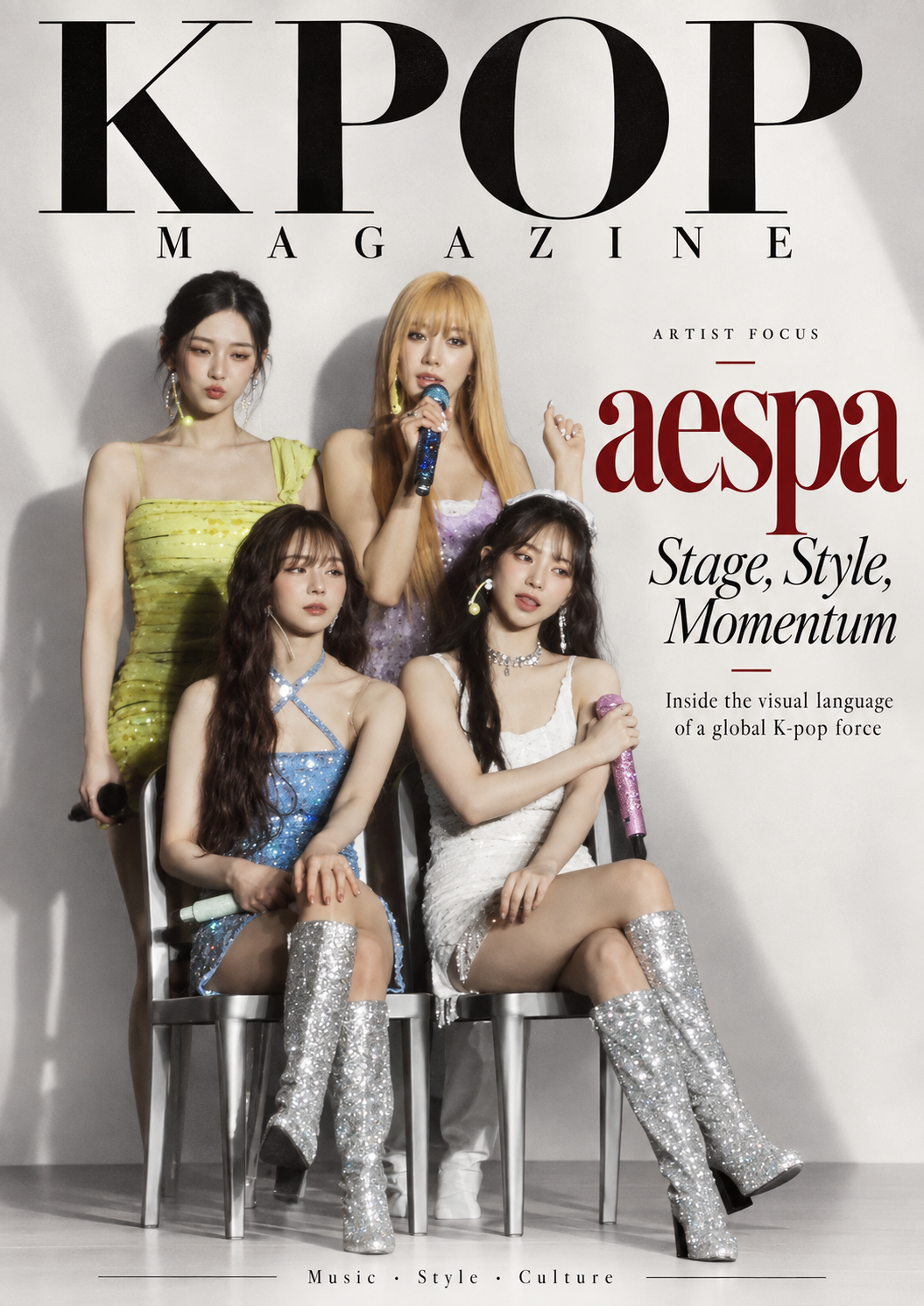
Adapted by KPOP MAGAZINE. Full cover credits ↓
A NEW VISUAL LANGUAGE IN K-POP
In K-pop, style is rarely just decoration.
It shapes how a comeback is remembered, how a performance feels, and sometimes how an artist is recognized before the music even begins.
Few groups show that more clearly than aespa.
From stage looks designed around demanding choreography to individual relationships with major luxury houses, aespa have built a visual language that now operates alongside their music.
Style has become part of the group’s identity.
Style was built into aespa from the beginning
aespa debuted with a concept that was highly visual from the start.
Their early identity combined futuristic imagery, digital avatars, highly constructed performance worlds and sharp visual storytelling.
That meant styling could never exist separately from the concept.
Hair, makeup, silhouettes and stage clothing had to support the same world as the music and choreography.
Over time, aespa’s visual language became less dependent on one specific futuristic aesthetic.
What remained was the sense of control.
Even as the clothes changed, the image still felt deliberate.
Stage styling has to work before it can look good
The most interesting part of aespa’s styling may be what happens behind the stage.
In a 2026 Vogue Taiwan interview, styling duo Ibaekilho discussed their work with aespa and explained that the group’s performance intensity directly affects how clothing is designed. They begin by considering choreography, movement paths and how the members’ bodies need to move before finalizing styling details. [1]
That is an important distinction.
A fashion image only needs to survive the photograph.
A stage outfit has to survive:
- choreography
- lighting
- sweat
- camera movement
- rapid costume changes
- repeated performances
Ibaekilho also described the challenge of concert quick changes, where closures, accessories and garment construction may need to be altered so an outfit can be removed within seconds without compromising the stage image. [1]
In other words, styling in K-pop is partly fashion and partly engineering.
A look has to
move.
Choreography and range of motion shape the silhouette.
Texture, proportion and detail must read on stage and on screen.
Fastenings and accessories must work within the show’s timing.
aespa’s visual identity works because the members do not all look the same
Strong group styling does not mean every member has to project the same image.
aespa’s fashion identity works partly because the members can occupy different visual spaces while still feeling like part of one group.
Karina’s relationship with Prada is one example.
At the 2026 Met Gala, she appeared in a custom Prada look that incorporated references to traditional Korean dress alongside details from Prada’s archive. Vogue noted that she has been a Prada ambassador since 2024. [2]
The look was not simply a luxury-house placement.
It connected Karina’s individual image, Korean visual references and Prada’s own design language.
That is what makes a fashion partnership feel more convincing.
Giselle shows another side of the group
Giselle’s relationship with LOEWE works differently.
LOEWE identifies her as a brand ambassador and featured her in its Spring/Summer 2026 pre-collection campaign, with denim-inspired leather bags and the Hammock Flip. [3]
The campaign presents a more relaxed, fashion-forward version of Giselle.
That contrast is important.
A group can maintain a strong collective identity while individual members develop separate fashion relationships.
The result is not fragmentation.
It can actually make the group feel larger.
Luxury fashion is now part of K-pop image-making
Luxury partnerships are no longer separate from idol image strategy.
For fashion houses, K-pop artists bring global visibility, young audiences and cultural relevance.
For artists, fashion partnerships can strengthen a visual identity that already exists.
But the strongest collaborations usually work when the brand does not completely overwrite the artist.
They amplify what is already there.
Karina in Prada feels different from Giselle in LOEWE because the partnerships are built around different visual personalities.
That difference matters.
One identity.
Different expressions.
KARINA × PRADA
Archive meets
personal reference.
A custom 2026 Met Gala look connects Prada’s design history with a hanbok-inspired neckline.
Explore the reported look ↗GISELLE × LOEWE
Craft meets
everyday movement.
LOEWE’s SS26 pre-collection story pairs Giselle with leather interpretations of denim and the Hammock Flip.
Explore the official campaign ↗Stage styling and luxury styling are not the same job
It is easy to group all fashion around an idol into one category.
But the objectives are different.
A luxury campaign needs to represent the fashion house.
A stage outfit needs to represent the artist while also functioning physically.
That means the styling team is constantly translating between different demands.
A garment may need to be:
- shortened
- reinforced
- re-fastened
- simplified
- altered for movement
- changed for lighting
- rebuilt for a quick change
Those decisions may never be visible to the audience.
But they determine whether the final image works.
The visual system is bigger than clothes
Style is not just the outfit.
It includes:
- hair
- makeup
- proportions
- accessories
- silhouette
- color
- staging
- photography
- movement
That is why aespa’s visual identity feels stronger than any single look.
The group can move from futuristic styling to softer fashion imagery or luxury campaigns without losing recognizability.
The clothes change.
The visual logic remains.
The clothes change.
The visual logic remains.
BY DESIGN
Style can become as recognizable as sound
A K-pop group is not remembered only through songs.
Sometimes recognition begins with a silhouette.
A hairstyle.
A stage outfit.
A fashion-house relationship.
A photograph.
Those elements can become attached to an era just as strongly as the music itself.
aespa’s strength is not that they always look the same.
It is that even when they change, the image still feels intentional.
Style is no longer separate from the music
For modern K-pop, fashion is not something added after the music is finished.
It is part of the creative system.
The stylist responds to choreography.
The fashion house responds to the artist.
The artist becomes part performer, part visual identity and part cultural reference point.
aespa make that system especially visible.
Music.
Performance.
Fashion.
Brand partnerships.
Visual direction.
They work together.
And that may be the real role of style in K-pop:
not simply to make an artist look good, but to make an artist instantly recognizable.