What Does It Actually Take to Reach No. 1 on Billboard?
Streams, radio, sales—and everyone else releasing music that week. Why the Hot 100 and Billboard 200 have different routes to the top.
 A KPOP MAGAZINE guide to two different charts.
Independent editorial coverage.
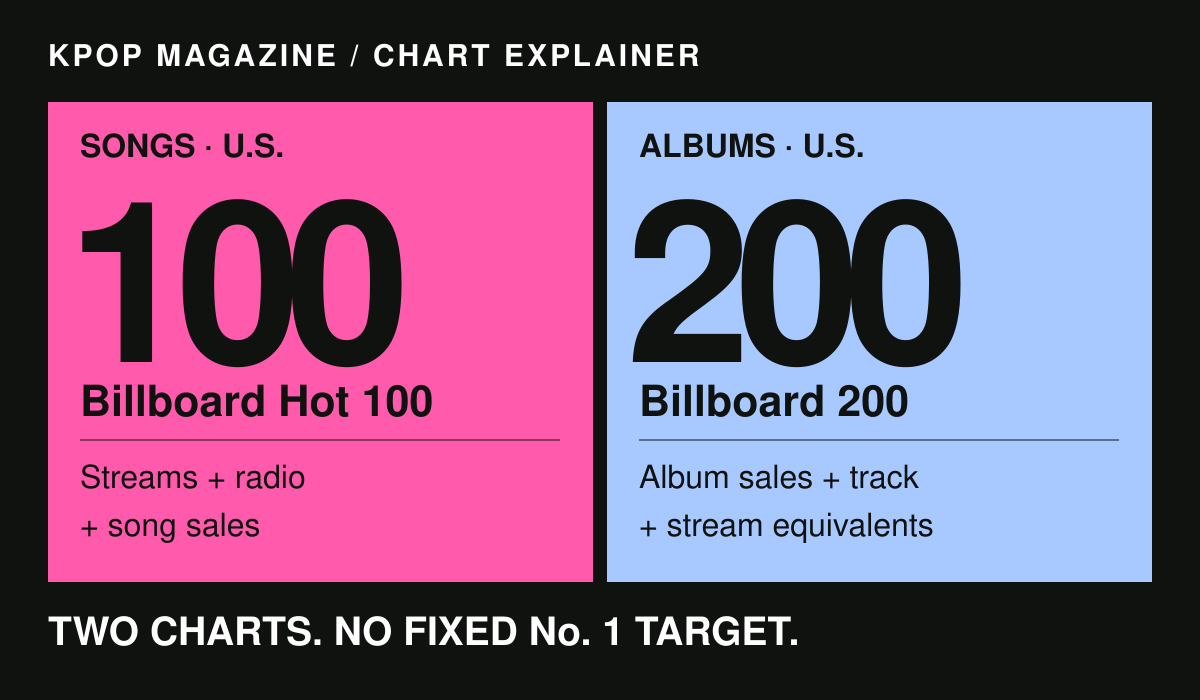
Conceptual comparison, not an official chart or a calculation of chart points. Diagram: KPOP MAGAZINE. Logo: Billboard / Wikimedia Commons · Source and reuse details.
A million streams? Ten million? A sold-out album drop? There is no single number that guarantees a Billboard No. 1. The position depends on the chart, the eligible activity being measured and the competition in that particular week.
For artists and fans, that distinction changes the question. Before asking how much support a release needs, ask which chart it is trying to top.
The Hot 100 ranks songs. The Billboard 200 ranks albums. Both describe the U.S. market, rather than an artist’s worldwide totals. Billboard’s Global 200 is a separate chart.
The Hot 100 measures a mix
The Hot 100 combines eligible U.S. streaming, radio airplay audience and song sales. Luminate compiles the underlying data; Billboard applies its chart rules to the published ranking.
Those inputs are weighted, not added together one-for-one. A radio audience impression, a purchased download and a stream are different measurements.
A release can compensate for a weaker component with strength elsewhere. Radio is not a mandatory hurdle every No. 1 must clear, and topping all three components is not a requirement.
Luminate publishes equivalent-weighting guidance, but knowing conversion ratios is different from knowing the winning total. There is no fixed stream count that guarantees first place.
Streaming: eligibility comes before scale
Large listening numbers matter only to the extent that they qualify for the relevant chart. A global Spotify total or the public view counter on a music video is not the same thing as eligible U.S. chart activity.
Luminate’s tracking guidance describes minimum continuous listening requirements, logged-in users and daily per-song, per-user caps. Repeating a song indefinitely does not create unlimited eligible streams.
Paid and ad-supported listening also carry different weights. That is why two releases with similar raw totals may generate different equivalent activity.
Radio reaches listeners; sales record purchases
Radio is measured through audience
The Hot 100’s airplay component uses estimated U.S. radio audience impressions. It is not simply a count of how many times a station plays a song.
Radio can develop on a different timetable from release-week streaming. That can help explain why an established song remains competitive after a newer release attracts a burst of listening. The exact contribution depends on the week’s data; radio exposure alone does not guarantee a chart position.
Not every purchase is eligible
Eligible physical singles and digital track purchases can contribute to the Hot 100. Billboard’s methodology notes distinguish full-service digital music retailers from direct-to-consumer artist websites, whose digital single sales are excluded from Hot 100 calculations.
That exclusion concerns digital singles. It should not be generalized to every physical single, album or direct-to-consumer transaction.
For a campaign, the important question is not merely whether fans can buy something. It is whether that particular product and transaction qualify under the applicable chart rules.
A song-chart milestone: BTS


When “Dynamite” debuted at No. 1 on the Hot 100 in 2020, the achievement belonged to a song. Billboard’s contemporary video report below records that milestone. It was not an album-chart result, and it should not be read as a numerical recipe for a release in 2026.
That is the practical value of naming the chart in full. “BTS topped Billboard” leaves a reader guessing about the work, the market and the measurement. “Dynamite debuted at No. 1 on the Hot 100” identifies the achievement. Explore the group’s musical history in our BTS Artist Hub.
Watch Billboard’s own report on the “Dynamite” Hot 100 debut. Historical reporting; today’s methodology is explained separately in this article.
So how many streams does No. 1 take?
There is no fixed answer because a ranking is relative. The same performance can finish in different positions against different competitors.
A new song faces releases with less weighted activity. Its mix of listening and purchases may put it in contention.
The identical song totals face a much stronger field. Its position can fall even though its own performance has not changed.
Hypothetical comparison only. No chart-point formula, forecast or real weekly result is represented.
Release timing can affect the competitive landscape, but it cannot turn an uncertain result into a guarantee. Nor does a lower placing necessarily mean a release reached fewer people than a higher-charting song in another week.
The useful comparison is eligible weighted activity against other eligible releases during the same tracking period. Luminate describes the standard chart tracking week as Friday through Thursday; the chart’s issue date and the dates when its activity occurred are not interchangeable.
The Billboard 200 asks a different question
The album chart combines traditional album sales, track-equivalent albums (TEA) and streaming-equivalent albums (SEA). It does not add a separate radio-airplay component.
Billboard’s 2026 change took effect with the January 17-dated album chart, covering January 2–8 activity. The streaming conversion became 1,000 paid/subscription streams or 2,500 ad-supported streams per album unit.
2026 U.S. album-chart equivalents. Actual totals combine eligible activity across these routes. Streaming means qualifying official audio/video consumption from included providers. Source: Luminate equivalent weighting and Billboard’s methodology announcement.
This is an equivalence system, not a rule saying an album must succeed in every category. A release can be driven mainly by purchases, mainly by streaming, or by a combination.
A real example: a streaming-led No. 1
Drake’s ICEMAN opened at No. 1 on the Billboard 200 dated May 30, 2026, with 463,000 equivalent album units earned in the U.S. during the week ending May 21, according to Billboard’s report.
463,000 total units
- Streaming equivalents (SEA)
- 449,000
- Album sales
- 13,000
- Track equivalents (TEA)
- 1,000
Rounded figures reported by Billboard. SEA represented 462.2 million official on-demand streams. Bar shows the unit mix, not raw stream counts.
Almost all of that total came from streaming equivalents. An album with a much stronger physical-sales share could reach a similar overall total through a very different route. “No. 1 album” does not describe one universal pattern of listening or buying.
A purchase-led contrast: Stray Kids’ ATE

.png)
Stray Kids’ ATE offers a different pattern. On the August 3, 2024-dated Billboard 200, it debuted at No. 1 with 232,000 U.S. equivalent album units. Album sales supplied 218,000 of them, according to Billboard’s original report.
232,000 units: about 94% from album sales
- Album sales
- 218,000
- Streaming equivalents (SEA)
- 13,000
- Track equivalents (TEA)
- 1,000
Graphic: KPOP MAGAZINE. Rounded Billboard figures; 218,000 ÷ 232,000 ≈ 94%. The 2024 streaming conversion differed from 2026. These two historical examples illustrate different unit mixes, not a same-week contest or a recalculation under identical rules.
Billboard also described multiple collectible CD editions. That supplies useful context for the sales-heavy total, but does not establish how many individual people bought them. The contrast with ICEMAN is about the composition of each result. Neither mix tells us whose fans care more. Continue with the Stray Kids Artist Hub.
Why the distinction matters for K-pop
An audience willing to buy albums can make a substantial contribution to the Billboard 200. Eligible physical purchases remain part of the calculation; streaming did not replace them.
But buying an album does not directly become a song sale for the Hot 100. The title track must compete on its own eligible song activity. That makes an album No. 1 and a Hot 100 No. 1 different achievements, even when they belong to the same release campaign.
Fan organization can concentrate attention during an opening week. What these charts cannot tell us by themselves is how many listeners are dedicated fans, how many are casual listeners, or whether either group values the music more deeply.
It is therefore too simple to declare that a strong debut is merely fandom activity, or that only radio makes a hit legitimate. The data measures specified behaviors—not the authenticity of an audience.
Before sharing a “No. 1” headline
- Name the chart. A song ranking and an album ranking answer different questions.
- Check the market. U.S. chart activity is not a worldwide listening total.
- Check the week. The chart date and the period when activity happened can differ.
- Read the unit mix. Sales, equivalent units and raw streams are different quantities.
KPOP MAGAZINE’s view: the week after matters too
For us, the interesting question is what happens after the opening campaign. Does the song keep finding listeners? Does an album continue to be played after its first-week sales? Can a release sustain attention across more than one route?
Reaching people beyond those already waiting for an artist can expand that opportunity. It is an editorial judgment about durability, not an extra eligibility rule or a prerequisite for No. 1.
Billboard No. 1 remains a specific achievement: leading the eligible field under a particular chart’s rules in a particular tracking period. Understanding the method makes the achievement clearer—and keeps a single rank from being asked to explain everything about a song.
Methodology and image rights reviewed October 5, 2026. Originally published September 29, 2026; updated with Library photography, historical case studies and explanatory graphics on October 5. This is an independent explainer, not an official Billboard guide or a chart forecast. Rules and provider participation can change; linked primary sources take precedence over campaign advice.
Billboard logo: Billboard / Wikimedia Commons. The file is classified as public-domain text/shape artwork; trademark rights remain separate. Resized proportionally, without cropping or recoloring. No affiliation or endorsement is implied.
_logo.svg)
Comparison cover, conversion guide, unit-mix graphics and reading checklist: original KPOP MAGAZINE graphics, using the linked methodology and published figures. Adapted from the S.I.Q. manuscript “What Does It Actually Take to Reach No. 1 on Billboard?” Photos retain the authors’ CC BY licenses and are used as editorial archive illustrations, without implying endorsement. Video is an official Billboard embed; no video or thumbnail was copied.
Related: Korea’s entertainment-company revenues explained · More explainers