Solar’s “To My 20s” Opens a Door Back to COLOURS
A weekend listening route through “Colors,” “Empty” and Solar’s new single, tracing three forms of reassurance and the collaborators behind them.
A letter to your younger self has two readers: the person you remember being, and the person who has to live with that memory now. Solar’s new single, “To My 20s (Harmonica. Hareem),” makes that distance its subject. Released on November 12, it offers a timely reason to return to an older thread in her solo work: the different ways a song can give someone permission to be themselves.
RBW’s release notes describe a message to the younger Solar who was working toward her dream. The perspective is affectionate toward effort whose outcome was still uncertain. The notes also extend the song’s reassurance to people moving through their own lives at their own pace.
That premise changes the question a retrospective song asks. A list of achievements would tell us what the younger person eventually accomplished. A letter can ask what that person needed to hear while everything was still unresolved. The difference gives this single an interesting place beside the more outward-facing confidence of COLOURS.
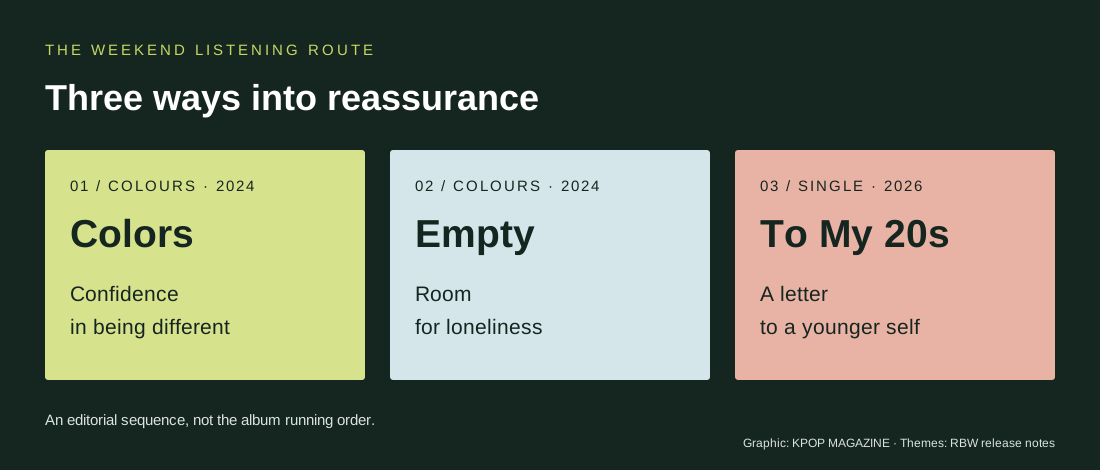
Reassurance can take more than one form
Released on April 30, 2024, COLOURS places six songs inside a deliberately varied musical palette. In the accompanying artist notes, Solar connects that variety with respect for people’s different identities and tastes. “Colors,” the opening house track, turns toward confidence in being visibly different; “Empty,” a pop ballad, makes room for loneliness.
Their positions matter to a listener approaching the record now. An opening statement of confidence does not make the later lonely song a contradiction. Together they allow more than one emotional state to belong to the same person. A record about individuality can include the days when being yourself feels difficult, as well as the days when it feels exhilarating.
“To My 20s” offers another perspective on that idea. Here, the person receiving understanding is an earlier version of the singer. Read alongside the album’s stated concerns, the single suggests a useful continuity: making room for difference can also mean allowing your past self to have been uncertain. This is a connection between the releases, rather than a claim that Solar planned them as a series.
A personal voice, with collaborators in view
The credits make the comparison more precise. Solar has the sole lyric and composition credits on “Colors”; its arrangement is credited to Kim Do Hoon and Seo Yong Bae. “Empty” also credits Solar for words and music, with Jin Min Ho arranging. On the new single, she writes the lyrics and shares both composition and arrangement with Lee Hoo Sang.
Hareem’s contribution is identified directly in the new song’s title: harmonica. That small piece of information provides an unusually clear invitation to follow an instrumental part. It also preserves a distinction that the word “collaboration” can blur: playing an instrument, writing a song and shaping its arrangement are different contributions.
Three songs, three credit patterns
| Song | Lyrics | Composition | Arrangement |
|---|---|---|---|
| Colors | Solar | Solar | Kim Do Hoon · Seo Yong Bae |
| Empty | Solar | Solar | Jin Min Ho |
| To My 20s | Solar | Solar · Lee Hoo Sang | Solar · Lee Hoo Sang |
Sources: Bugs, “Colors” and the linked RBW album notes. Korean credits: 김도훈, 서용배, 진민호 and 이후상. English names are transliterations. Hareem (하림) plays harmonica on “To My 20s.” This table covers the named writing and arrangement roles, not a complete studio personnel list.
Watch “To My 20s”
A three-song route for the weekend
Start with “Colors,” move to “Empty,” then finish with “To My 20s.” This deliberately leaves the album’s running order. It is a way to compare three kinds of address: confidence shared outwardly, loneliness acknowledged, and understanding offered across time.
- Follow the address. Read the official song descriptions before listening. Who seems to receive each song’s reassurance? Does that change how you approach the vocal?
- Follow one instrumental part. On “To My 20s,” use Hareem’s credit as a guide. Notice where the harmonica and voice draw your attention, and how the space between phrases affects the exchange.
- Reverse the route. Return to “Colors” after the new single. Does confidence feel different when you have just spent time with a more reflective premise?
Those questions leave the listening experience open. Release notes establish the intended themes; credits identify contributors. The listener still gets to decide how those things meet in the recording. Solar’s newest song makes a good starting point for that return visit: a short letter can send you back through a catalogue with a different question.
Reporting checked November 15, 2026. Release information and credits come from label-supplied music-platform records. Connections between songs and listening prompts are KPOP MAGAZINE analysis; no interview, studio access or firsthand playback review is claimed. No song lyrics, photographs or video stills are reproduced.